Best of 2026-07-06 — Aquarium Gear That Keeps Fish Alive, Water Clear, and Your Sanity Intact
Best of 2026-07-06 — Aquarium Gear That Keeps Fish Alive, Water Clear, and Your Sanity Intact
Nobody tells you when you buy your first fish tank that you're signing up to be a part-time chemist, plumber, and electrician. One week in, you're Googling "why is my water cloudy" at 2 AM while your betta gives you the side-eye from behind a fog of bacterial bloom. The right gear turns this from a stress-induced migraine into something approaching a hobby you actually enjoy. Here's the stuff that earned its spot on real tanks, based on thousands of reviews from people who've already made every mistake so you don't have to.
1. So Quiet You'll Check It's Running — This Filter Keeps Tanks Crystal Clear for Weeks
There are two kinds of aquarium filters in this world: the ones that sound like a dishwasher running a heavy cycle next to your pillow, and the ones that make you walk over and touch the tank just to confirm they haven't died. The Aqueon QuietFlow 20 falls squarely in the second camp. Owners across thousands of reviews keep using the word "silent" like they can't quite believe it themselves. One person with a 10-gallon in their bedroom said they literally can't hear a thing — which, if you've ever tried to sleep next to a bubbling HOB filter, is basically a miracle.
What buyers love: The setup takes about five minutes and the all-in-one cartridge design means no fiddling with separate sponges, charcoal pouches, and mysterious plastic clips you'll definitely lose. The built-in LED blinks when the cartridge is due for a change, which is brilliant because nobody actually remembers when they last swapped filter media. Flow is strong — maybe too strong for a betta — but a quick DIY baffle solves that. Several owners report crystal-clear water for a full month between cleanings, which is roughly three weeks longer than they'd admit to going otherwise.
What to watch for: The dark side of this filter's popularity is a recurring complaint about pump failure. A small but vocal group of buyers had their QuietFlow stop working entirely after a few months — and the cartridge design means you can't just replace the pump; you're buying the whole unit again. If yours survives the break-in period, you're golden. If not, well, at least it was quiet while it lasted.

2. Set It and Forget It — Sunrise-to-Moonlight LED That Makes Plants Thrive on Autopilot
Manual light timers are the aquarium equivalent of remembering to floss: everyone intends to do it, nobody does, and eventually you just lie to yourself about it. The hygger 18W solves this by automating the entire day-night cycle — sunrise ramp-up, full daylight, sunset dim-down, and a soft blue moonlight mode that makes your tank look like a premium nature documentary. You plug it in, pick the 24/7 mode, and walk away. That's it. Your plants get consistent photo-periods, your fish get a natural rhythm, and you get to stop lunging for the power strip at 10 PM.
What buyers love: The customizable DIY mode gives planted tank nerds full control over brightness and color spectrum, including reds and blues that make stem plants go absolutely wild. At 18 watts it's bright enough to punch through medium-depth tanks without bleaching everything. Customer support is shockingly good — one reviewer had a unit fail, sent Hygger a 30-second video, and had a replacement shipped within two weeks, no return required. The waterproofing on the light bar itself gets praise from people whose splash-prone lids have murdered lesser fixtures.
What to watch for: The extendable bracket legs slide freely without any locking mechanism, so if you bump the light while doing maintenance, it'll shift and potentially dip a corner into the water. One buyer received a unit missing the power adapter entirely — rare, but worth checking the box before you toss the packaging. A few units have failed after a couple of months, though the responsive warranty process softens that blow considerably.

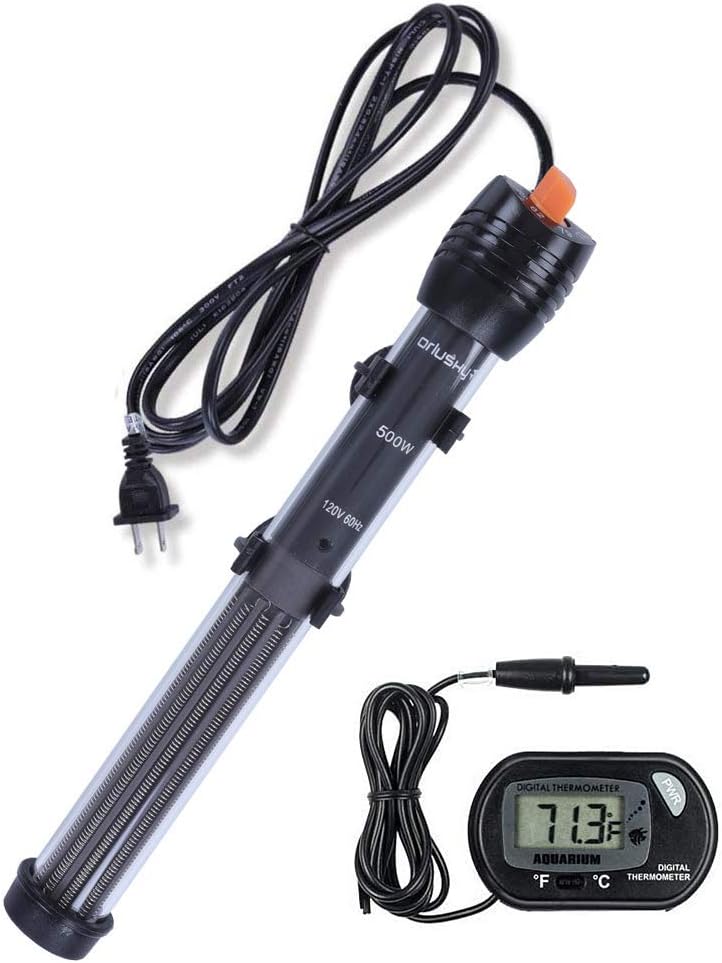
3. Dial It In and Forget It — Submersible Heater That Keeps Temps Steady for Turtles and Tropical Fish Alike
Aquarium heaters are the one piece of equipment where "close enough" can become "mass casualty event" in about four hours. The Orlushy submersible has earned 8,000+ reviews by being mostly reliable at a price that doesn't make you wince — currently hovering around $19 for a unit that handles tanks up to pretty respectable sizes. It's fully submersible (yes, the whole thing goes underwater), works in freshwater and saltwater, and comes with a stick-on thermometer so you can verify the temperature independently instead of blindly trusting the dial.
What buyers love: The dial adjustment is refreshingly simple — no digital menu diving, no app pairing, just twist to your target temp and let it run. Turtle keepers are particularly vocal fans; one Florida owner credited this heater with saving their red-eared sliders during an unexpected cold snap. Multiple long-term reviews from people 6-12 months in confirm it holds temperature consistently enough that they stopped obsessively checking the thermometer every hour. That's about the highest praise a budget heater can get.
What to watch for: Here's the part where you need to pay attention. A handful of buyers — including one memorable review titled "thanks for cooking all my beneficial bacteria" — experienced wild temperature overshoots. Set to 81°F, came home to 87°F and a heater still running hot. One unit arrived with shattered glass straight out of the box (replacement was fine). The lesson: always run a new heater for 24 hours in a fishless tank with a separate thermometer watching it. Most units are fine, but the ones that aren't can wipe a tank.
4. Dip, Wait, Compare — Quick 8-in-1 Strips That Catch Water Problems Before Your Fish Do
Water testing is the aquarium chore that separates the "I've had fish for three years" crowd from the "why do my fish keep dying" crowd. The AAwipes 8-in-1 strips make it stupidly simple: dip for a few seconds, hold horizontally for 30 seconds, compare to the color chart on the bottle. You get pH, ammonia, alkalinity, hardness, chlorine, nitrite, nitrate, and one more parameter you'll probably never need but it's nice to have. Fifty strips for under ten bucks means you can test daily without feeling like you're burning money.
What buyers love: The speed is the real selling point. Liquid test kits are more precise but require a chemistry-set ritual involving glass vials, precise drop counts, and vigorous shaking that makes you look like you're mixing a tiny cocktail for your fish. These strips are done in 30 seconds flat. Several reviewers noted they caught nitrite spikes early enough to intervene, which is literally the difference between "minor water change" and "funeral arrangements." The strips are individually sealed so humidity doesn't ruin the batch before you use them.
What to watch for: The ammonia test pad is the weak link. Multiple experienced keepers report it reading zero even in tanks they knew were mid-cycle with heavy bioloads. If ammonia accuracy matters to you (and it absolutely should), use these for the other seven parameters and back up the ammonia reading with a liquid kit. The pH reading also tends to run about 0.5 higher than API strips, so keep that offset in mind. These are a screening tool, not a precision instrument — treat them accordingly.

5. See the Gunk, Suck the Gunk — The Gravel Vac That Makes Water Changes Less of a Wrestling Match
Gravel vacuuming is the aquarium equivalent of cleaning the gutters — nobody wants to do it, but ignoring it leads to problems you can smell from across the room. The Tetra Water Cleaner is the definition of "it just works." A clear plastic vacuum tube attached to a kink-resistant hose with a simple hand pump to start the siphon. You squeeze the bulb a few times, gravity takes over, and suddenly you're watching weeks of fish waste and uneaten food swirl up through the clear chamber like a very gross snow globe.
What buyers love: That clear chamber is the star of the show — being able to see what you're actually pulling out of the gravel is weirdly motivating. No more blind sucking and hoping. The 3/8-inch tubing resists kinking better than the bargain-bin siphons that fold in half the moment you turn your back. At around ten dollars, replacing it every year or two doesn't sting. One turtle tank owner called it a "must have" after upgrading from the insanity of tipping a partially filled 20-gallon tank on its side to clean gravel. Yes, people actually do that. Don't be those people.
What to watch for: The hose is fine for 20-gallon tanks but feels short if you're running a 55-gallon setup with any distance between the tank and your drain bucket. The hand pump bulb works but doesn't inspire confidence for daily commercial use. Suction is moderate — it'll pull up loose debris and light mulm, but heavily compacted gravel beds might need a couple passes. No attachments included, so if you keep sand or planted substrate, look for a kit with different nozzle options.

Bottom Line
Aquariums are one of those hobbies where the difference between "this is my peaceful Zen corner" and "I just spent $200 to create an underwater crime scene" comes down entirely to equipment that works. Every product here has thousands of reviews backing it up — including the critical ones, because the negative reviews often tell you more than the glowing five-star ones ever will. Check your heater with a separate thermometer, back up your test strips with a liquid kit for ammonia, and for the love of fish, get a gravel vac before your substrate turns into a biological hazard zone.
🛒 Ready to Shop?
All products featured in this guide are available on Amazon. Use the link below to start shopping for your pet — it supports our work at no extra cost to you.
Shop Pet Supplies on Amazon →🔥 Recommended Products