Best of 2026-07-18 — Aquarium Gear That Keeps Fish Alive and Actually Makes Water Changes Less of a Chore
Best of 2026-07-18 — Aquarium Gear That Keeps Fish Alive and Actually Makes Water Changes Less of a Chore
Keeping an aquarium is basically running a tiny wastewater treatment plant inside your living room — except the residents are dramatically expressive tropical fish who will sulk for three days if the pH dips by 0.2. No one warned us that "getting a fish tank" really means "becoming an amateur water chemist, electrician, and part-time janitor." The good news? The right gear turns the weekly maintenance slog into something that takes twenty minutes instead of two hours. Here's what actually works, straight from the people who've already flooded their floors and accidentally cooked their angelfish so you don't have to.
1. This Hang-On-Back Filter Runs So Quietly You'll Wonder If You Even Plugged It In
There's a special kind of buyer's remorse that hits at 2 AM when your new aquarium filter sounds like someone's running a blender full of marbles in your bedroom. Every aquarium owner has been there — standing in the dark, jiggling the intake tube, googling "HOB filter rattling noise fix" on their phone. The problem isn't always user error; some filters are just built loud.
What buyers love: The hygger 315 GPH HOB filter changes the game on noise — multiple owners say they literally have to watch the water outflow to confirm it's running. The adjustable flow dial means you can crank it down for delicate fish or open it up when your messy goldfish are doing their thing. The extendable intake tube reaches deep into taller tanks without any DIY hacks, and the multi-stage media basket handles mechanical, biological, and chemical filtration in one hang-on unit. Priming doesn't require the traditional "suck on a tube and hope you don't swallow fish water" technique — it starts with a simple button press.
What to watch for: That flow adjuster dial is stiff straight out of the box, and a few overenthusiastic owners managed to crack it by forcing the turn. If your tank is heavily stocked with big waste-producers, expect to rinse the intake sponge weekly — it clogs faster than advertised. Heads up for shrimp keepers: the intake doesn't come with a pre-filter sponge, so small inhabitants can take an unexpected ride into the filter chamber. The price is fair for a BestSeller, though the replacement cartridges cost more than the generic alternatives once you're locked into the ecosystem.

2. The Heater That Shuts Itself Off Before It Turns Your Tank Into Fish Soup
Every seasoned aquarist has a horror story about a heater that failed in the "on" position. You come home to a tank that's 94 degrees and inhabitants that are, charitably speaking, no longer with us. It's the aquarium equivalent of leaving the stove on — except your smoke detector won't catch this one. The heater is the one piece of equipment where failure isn't just inconvenient, it's catastrophic.
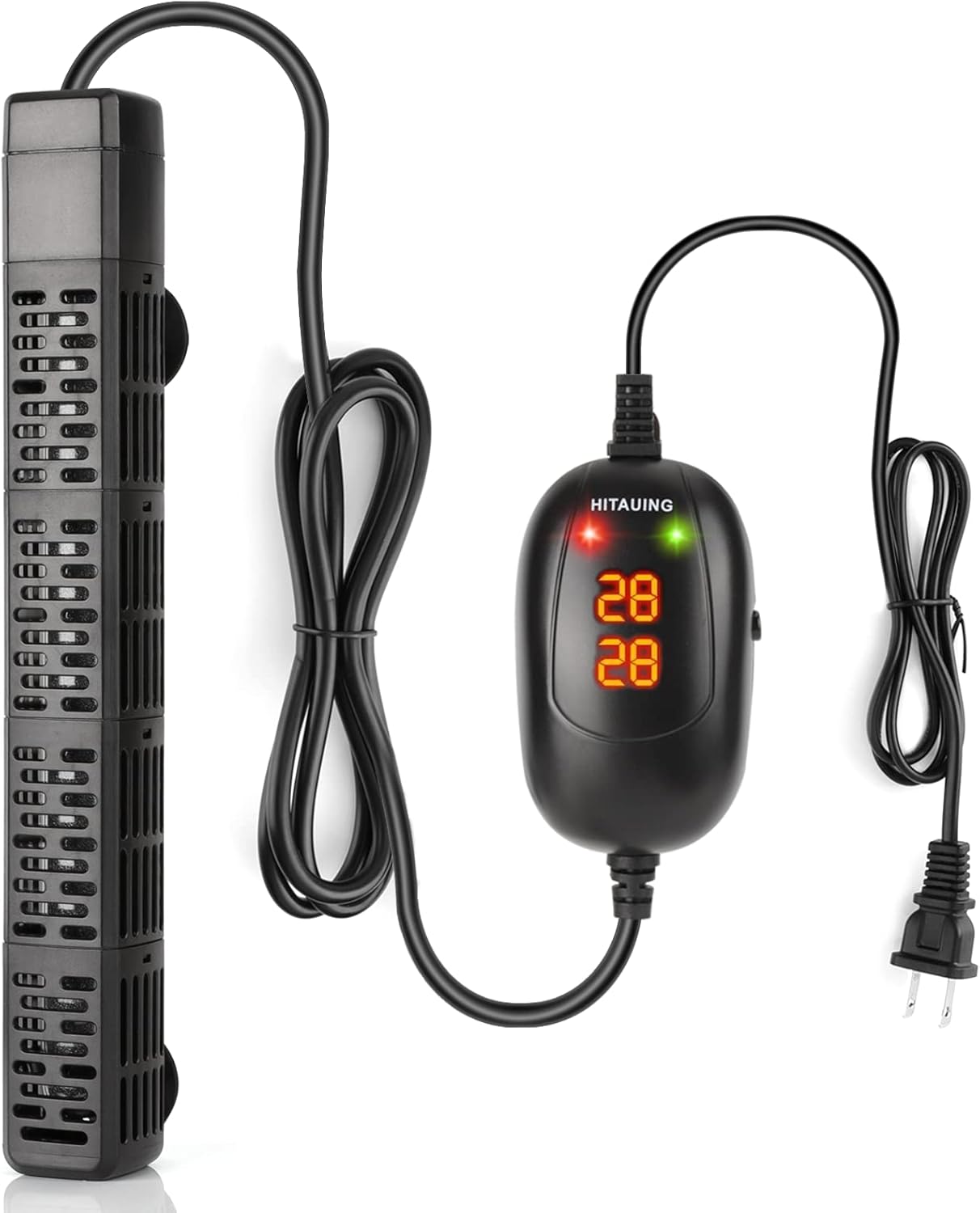
What buyers love: The HiTauing submersible heater earns its 4.5 stars across 2,400+ reviews because the safety features aren't just marketing fluff. The automatic shut-off when it leaves water actually works — pull it out during a water change without remembering to unplug it, and it powers down instead of cracking itself on your countertop. Temperature stability is tight at ±0.5°F once calibrated, and the external LED controller with touch buttons means you can adjust the set point without reaching elbow-deep into the tank. The quartz glass housing is thick enough to survive the inevitable clumsy drop during setup.
What to watch for: Calibration out of the box is the weak spot — roughly one in five units reads 2-3 degrees off from actual tank temperature. Budget for a separate glass thermometer to verify, because trusting the display blindly is how you end up with chilly tetras. The suction cups are the same generic ones every aquarium product ships with — they'll lose grip after 3-4 months and you'll find the heater floating sideways. For larger setups, the power cord on the 300W model is shorter than you'd like. And if you live somewhere with frequent power blips, know that this heater won't remember your settings after an outage — it defaults back to factory, so check it after every storm.
3. Your Plants Will Finally Do That Beautiful Pearling Thing — No Green Thumb Required
Let's be honest about planted tank lighting: most of us started with whatever fluorescent strip came with the tank and wondered why our "easy beginner plants" turned into brown mush within two weeks. Then we discovered that actual plant-capable lights cost more than the tank itself, and that was a different kind of pain. LED technology has come a long way, but finding one that balances spectrum quality, programmability, and not-destroying-your-budget is still a needle-in-a-haystack search.
What buyers love: The AQQA full-spectrum LED light hits the sweet spot. Its 24/7 cycle with gradual dimming through sunrise, daylight, sunset, and moonlight means your fish aren't startled by an abrupt 10 AM light blast — and you're not manually flipping a switch twice a day like a peasant. The IP68 waterproof rating isn't theoretical; several owners report accidentally dropping it fully into the tank and having it survive without a hiccup. The DIY spectrum mode is where the light really shines (pun intended) — you can mix red, blue, green, and white channels to dial in anything from a warm amber glow to crisp natural daylight. Plants that were barely hanging on started pearling within a week.
What to watch for: The companion app connects over 2.4GHz WiFi only — if you're on a modern dual-band mesh network that auto-selects 5GHz, prepare for a frustrating evening of router-settings-deep-diving. The internal timer drifts by about 10-15 minutes over a month, so mark your calendar for a monthly resync if you want the sunrise to actually happen at sunrise. The clock is 24-hour format with no AM/PM option, which shouldn't be a dealbreaker but somehow always confuses at least one person in the household. Most importantly: despite being found under a "48 inch" search, the extendable brackets max out at 32 inches — measure your tank before ordering, because a true 48-inch setup will need two of these.

4. An App That Reads Your Water Parameters So You Can Stop Playing "Which Shade of Yellow Is This?"
If you've ever held a liquid test tube up to a color chart under fluorescent kitchen lighting at 10 PM, squinting and oscillating between "definitely 0.25 ppm" and "maybe 0.50 ppm? I have no idea," you know the struggle. Water testing is the most important aquarium habit that nobody actually enjoys doing. It's tedious, it's subjective, and one misread can send you down a panic-spiral of unnecessary water changes.
What buyers love: The DROPLYTIX digital test kit takes the subjectivity out of the equation by using your phone's camera to read the strip and give you actual numbers — not color-matching guesswork. It tests 10 parameters in a single dip: the full nitrogen cycle (ammonia, nitrite, nitrate), plus pH, GH, KH, and chlorine — everything you need for a freshwater or saltwater health check. The companion app saves your results and builds trend graphs over time, so you can actually see your cycle stabilizing instead of just hoping it is. The fact that one kit handles both freshwater and reef tanks without separate sets of strips is a nice bonus.
What to watch for: The app's color recognition is sensitive to lighting conditions — scan in natural daylight near a window for the most consistent results; a dim room under warm bulbs will throw it off. The strips come tightly packed, and if you don't immediately reseal the bottle after grabbing one, humidity can cause the remaining strips to stick together (nothing like peeling apart two fused $0.70 test strips at 7 AM). A handful of users report nitrate readings that don't match their trusted liquid test kits, so if precision is critical, use this for trending and spot-check with liquid reagents. At this price point, the per-test cost runs higher than a traditional API master kit over the long haul.

5. The $10 Siphon That Five Thousand Reviewers Swear By — No Batteries, No Pumps, No Nonsense
At some point, every aquarium owner discovers that the single most-used piece of equipment in their arsenal isn't the fancy programmable light or the canister filter with more media trays than a filing cabinet — it's the humble gravel vacuum. Water changes are non-negotiable, and how pleasant or miserable they are comes down almost entirely to whether your siphon works first try or requires twenty minutes of frustrated bulb-squeezing.
What buyers love: The Tetra gravel siphon is proof that sometimes the simplest tool is the best one. No batteries, no electric pump, no smartphone app — just squeeze the bulb and physics takes over. The transparent gravel tube lets you watch debris get sucked up in real time, which is weirdly satisfying in a way that's hard to explain to non-aquarium people. The built-in clip that secures the hose to your bucket edge is one of those small details that makes you wonder why every siphon doesn't have it — no more hose popping out and spraying tank water across your rug. At $10, it's genuinely one of the best value-for-money items in the entire aquarium hobby.
What to watch for: The rubber bulb stiffens over time — after 6-8 months of regular weekly water changes, you'll notice it takes more squeezes to get the flow going. The standard hose length is fine for a tank on a typical stand, but if your setup sits low to the ground or you're draining into a bucket far away, you'll want an extension tube. The intake opening is sized for standard gravel; if you're using fine sand substrate, it'll get sucked right through unless you learn the pinch-the-hose technique. And yes, this is purely manual labor — if you were hoping for a push-button solution, this isn't it. But for ten bucks, the elbow grease feels like a fair trade.

Bottom Line
An aquarium is only as good as the gear keeping it running. Skip the filtration, and you're doing daily water changes. Cheap out on the heater, and you're gambling with your livestock. Ignore water testing, and you're flying blind. But you don't need to spend a fortune — these five pieces, from the silent HOB filter to the dead-reliable $10 siphon, cover the essentials without emptying your wallet. Your fish will thank you. Probably by ignoring you completely and begging for food, but that's just how the relationship works.
🛒 Ready to Shop?
All products featured in this guide are available on Amazon. Use the link below to start shopping for your pet — it supports our work at no extra cost to you.
Shop Pet Supplies on Amazon →🔥 Recommended Products