Best of 2026-07-27 — Aquarium Gear That Keeps Water Crystal Clear and Your Fish Actually Alive
Best of 2026-07-27 — Aquarium Gear That Keeps Water Crystal Clear and Your Fish Actually Alive
Look, nobody starts an aquarium thinking "I can't wait to spend Saturday afternoons elbow-deep in green water, scraping algae, and googling 'why did my tetra die' at 11pm." We get into this hobby because we saw a gorgeous planted tank on Reddit and thought, "How hard can it be?" Then six months later we own more test tubes than a high school chemistry lab and speak fluent ammonia-cycle. The right gear doesn't make you a master aquarist overnight—but it does stop you from becoming the person whose fish literally filed a complaint with the ASPCA.
1. A Skimmer That Earns Its Keep Without Making You Hate Your Life
Protein skimmers sit at the top of the "stuff I'll buy after my first algae bloom sends me into a spiral" list. If you've been running a saltwater tank without one, you're basically inviting dissolved organic waste to throw a pool party in your water column. The problem with most budget skimmers is they either sound like a lawnmower or produce about as much foam as a flat soda. Or both. Or they break on day three and you're back to staring at cloudy water wondering where your ninety dollars went.
What buyers love: The IOAOI DC pinwheel skimmer slides right into AIO chambers without a fight, and buyers consistently report it starts pulling actual brown gunk within 24 hours. Not "maybe later" skimmate—real, disgusting, "I can't believe this was in my tank" foam. The DC pump comes with a controller and feed mode button, which at this price is genuinely surprising. Micro bubbles, the eternal nemesis of every HOB skimmer owner, reportedly vanish within 48 hours. The packaging feels less "dollar store" than expected, and the drain line on the collection cup saves you from the daily ritual of unscrewing a slimy cup over your carpet.
What to watch for: The controller has a dark side. Multiple buyers report units that worked beautifully for two days then went full brick—controller off, never to wake again. Quality control seems to be playing roulette: one person unwrapped a unit caked in salt creep that was clearly someone else's return, sold as new. The collection cup won't fully detach without unplugging the airline, which is annoying at 7am on a water-change Saturday. And if you own a rimmed tank, this one's a pass. Great when it works—just maybe order from somewhere with a return policy that doesn't require a blood oath.

2. The Temperature Nanny Your Heater Desperately Needs
Aquarium heaters have exactly one job, and roughly 40% of them fail at it in the most dramatic way possible—usually by cooking your entire tank to a balmy 94°F while you're at work. That little dial on top of your submersible heater? About as accurate as a Magic 8-Ball. Which is why seasoned aquarists eventually buy a separate temperature controller and wonder why they ever trusted a $15 glass tube with the lives of their entire livestock.
What buyers love: The Inkbird ITC-308 is the Toyota Camry of aquarium temperature controllers—nothing flashy, nobody writes songs about it, but it just keeps working. Setup takes approximately ten seconds: plug it in, hold the set button, pick Fahrenheit or Celsius, tell it your target temperature range, done. The dual-stage design means one outlet runs your heater while the other can kick on a cooling fan—useful if your apartment turns into a sauna every July. The WiFi version lets you pull up tank temperature on your phone during a meeting, which is either peace of mind or a new anxiety disorder depending on your personality. Over ten thousand reviews averaging 4.6 stars, and it costs less than a takeout dinner for two.
What to watch for: Remember: this is a controller, not a heater. You still need an actual submersible heater plugged into it. The dual-outlet dongle arrangement is functional but looks like something your IT department would set up behind a server rack—not exactly elegant behind a rimless display tank. The 10A limit means if you're running multiple 300W heaters on a monster system, you'll need to do some math. And yes, the instruction manual reads like it was translated through three languages by someone who's never seen an aquarium. Good news: you won't really need the manual.

3. Light That Grows Plants Instead of Just Algae
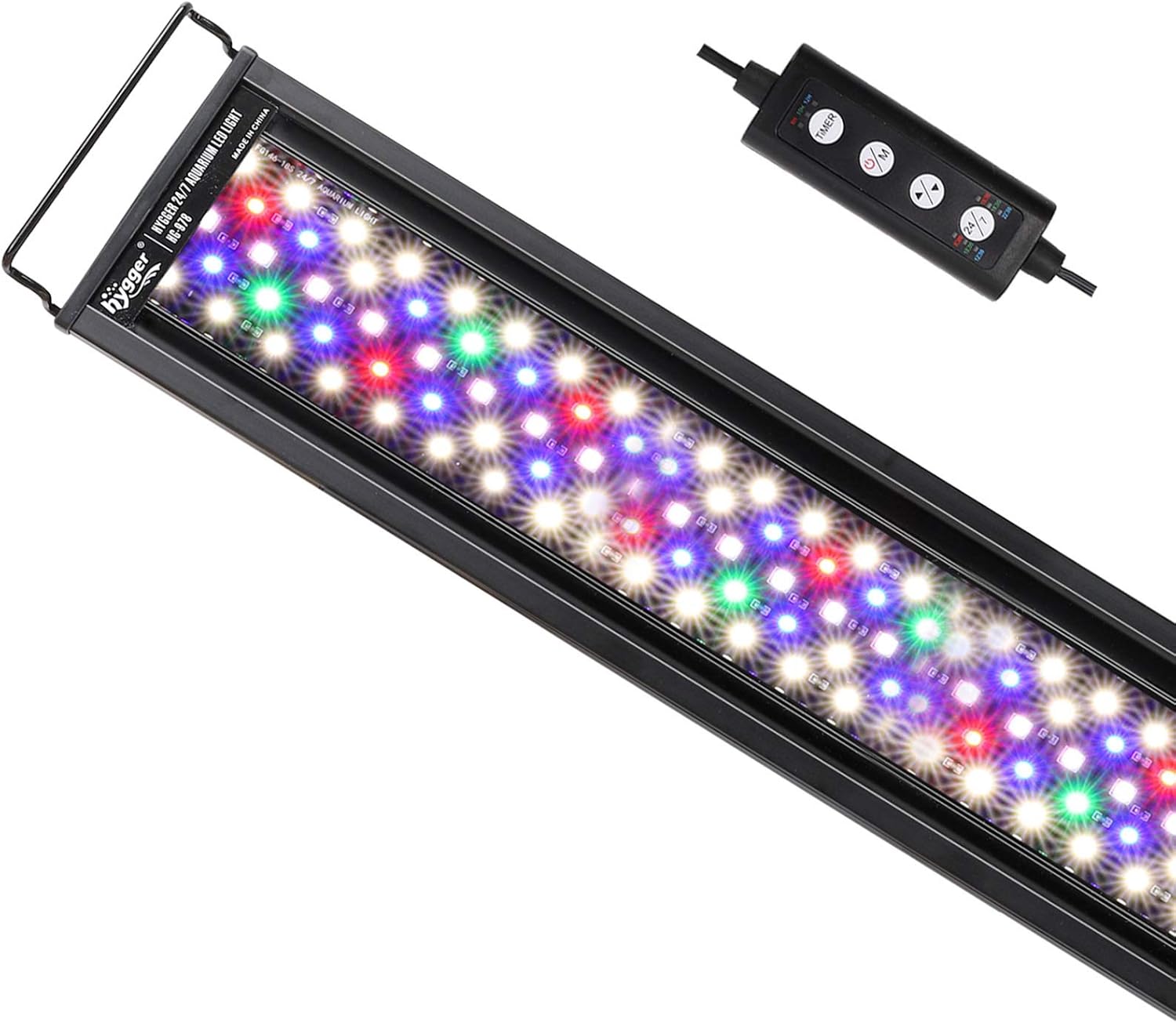
The aquarium lighting market is a masterclass in "how much can we charge for LEDs in a fancy aluminum housing." Walk into any fish store and you'll find lights that cost more than the tank, the stand, the livestock, and possibly your first car combined. Then there's the person in the comments section insisting that if you don't spend $400 on a light, your plants will grow backwards and your fish will develop seasonal affective disorder. The hygger light exists specifically to make those people uncomfortable.
What buyers love: The 24/7 cycle mode is the killer feature. It automatically ramps from dim sunrise orange through bright mid-day white to a moody moonlight blue, then shuts off. You never touch a timer again. Your fish get a natural light rhythm. Your plants photosynthesize like they're getting paid for it. The full spectrum output handles everything from nearly-indestructible Anubias to more demanding stem plants, and the slim body stays cool enough to touch—no built-in fan, no hum, no noise. Users running these for over two years report the LEDs haven't dimmed or shifted color. And at forty-something bucks for a 24-30 inch unit, it's priced like someone made a mistake in the spreadsheet.
What to watch for: Amazon fulfillment apparently can't distinguish a 60cm light from a 120cm light on a regular basis—more than one buyer opened a box sized for the right product only to find a half-length light inside. Annoying but fixable with a return. After a power outage, the light won't auto-resume its cycle; you have to physically press the button, which means no smart-plug workarounds. The 24/7 schedule looks beautiful but can't be customized hour-by-hour like a $200 light's app can. You're trading granular control for "set it and forget it." For most planted tank owners, that's a trade worth making.
4. The HOB Filter That's Trying to Do Everything at Once
Hang-on-back filters are the default choice for a reason: they're cheap, they work, and you can stuff whatever media you want inside. But most HOBs are glorified water movers—water goes in, passes through a disposable cartridge you're supposed to replace monthly (don't), and comes out slightly less dirty. hygger looked at this category and apparently thought, "What if we added a skimmer, a waste trap, and a drain valve and also made it look like a tiny canister?"
What buyers love: The built-in waste collector is genuinely clever—it catches gunk before it flows back into the tank, which means your water stays clearer between changes. The drain valve at the bottom threads onto standard tubing, so water changes become "open valve, drain into bucket" instead of "wrestle with siphon, accidentally drink tank water, swear repeatedly." It runs quiet—not "silent" in the marketing sense, but actually quiet enough that you forget it's there. Customizable media bay means you can toss in whatever bio-media, sponges, or chemical filtration you prefer. The surface skimmer attachment pulls the oily film off your waterline, which alone is worth the price for anyone who's ever stared at that iridescent sheen and felt personally attacked.
What to watch for: Out of the box, you're assembling a small IKEA project with twist-lock connections. Some units develop leaks from the bottom seal even when everything is tightened properly—which, for a device filled with water sitting next to your electrical outlet, is slightly terrifying. Despite the "shrimp-safe" intake label, tiny shrimp absolutely do find their way into the canister. Daily shrimp-rescue missions become part of the routine. The clear canister, while useful for spotting trapped livestock, also displays every speck of debris in 4K clarity. And a handful of buyers report the motor quitting at the three-month mark. At 3.8 stars, this filter is a gamble—when it's good, it's great; when it's not, you're mopping.

5. The Test Kit That Ends the Guessing Game
Test strips are the aquarium equivalent of checking your car's oil by kicking the tires. Sure, they're fast. They're also about as precise as a weather forecast from a groundhog. You dip, you wait, you squint at a color that's somewhere between "probably fine" and "oh no," and you make water-change decisions based on interpretive dance. The API Master Test Kit is what you buy after your first strip-related disaster, and once you switch, you never go back.
What buyers love: Liquid reagent tests give you actual ppm numbers—when you read 0.25 ppm ammonia, that's a real measurement, not a color between two vaguely different shades of beige on a strip. The kit includes pH, high-range pH, ammonia, nitrite, and nitrate—the five parameters that actually matter for keeping fish alive. With over 800 tests per kit, you'll be using this thing for years unless you're running a commercial hatchery. The instruction booklet is clear, the color cards are printed on proper card stock, and the glass vials have caps that don't leak. At 4.8 stars with 31,000+ reviews, this is less a "product" and more an "institution."
What to watch for: A full five-parameter test run takes five to ten minutes—this is a sit-down activity, not a quick dip. The glass vials are, well, glass. Drop one on a tile floor and you'll be finding shards until your next tank upgrade. Color matching under yellowish kitchen lighting can lead to questionable readings; good ambient light helps. The nitrate test bottle #2 needs aggressive shaking—like, arm-workout shaking—because the reagent settles and will give false low readings otherwise. No phosphate or hardness tests included, so if you're fighting algae or keeping sensitive shrimp, you'll eventually buy those separately. And yes, the reagents will stain your skin and possibly your counter if you're clumsy. (You'll be clumsy at least twice.)

Bottom Line
Keeping an aquarium isn't about buying the most expensive gear—it's about buying gear that doesn't create more problems than it solves. These five pieces cover the fundamentals: pulling waste out, keeping temperature steady, growing plants instead of algae, filtering without constant maintenance, and actually knowing what's happening in your water. Your fish won't send you a thank-you card, but they will stop floating upside down, and that's basically the same thing.
🛒 Ready to Shop?
All products featured in this guide are available on Amazon. Use the link below to start shopping for your pet — it supports our work at no extra cost to you.
Shop Pet Supplies on Amazon →🔥 Recommended Products


